






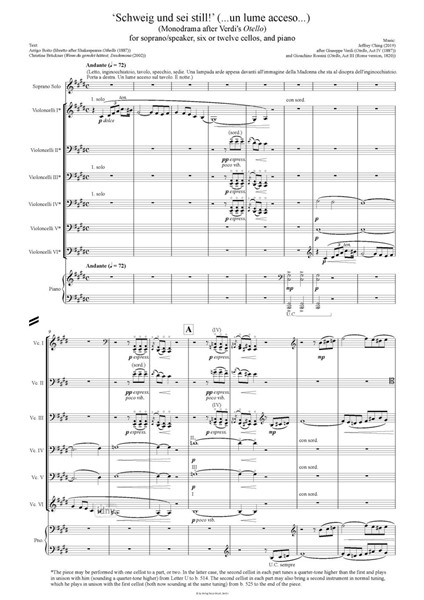
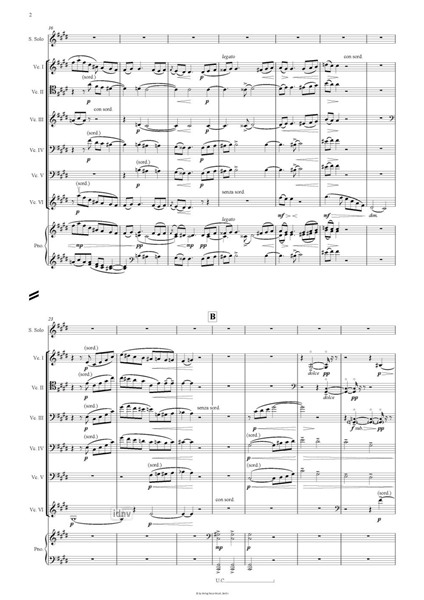
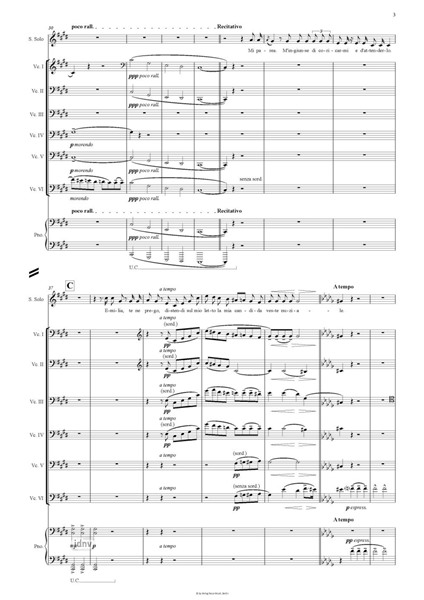
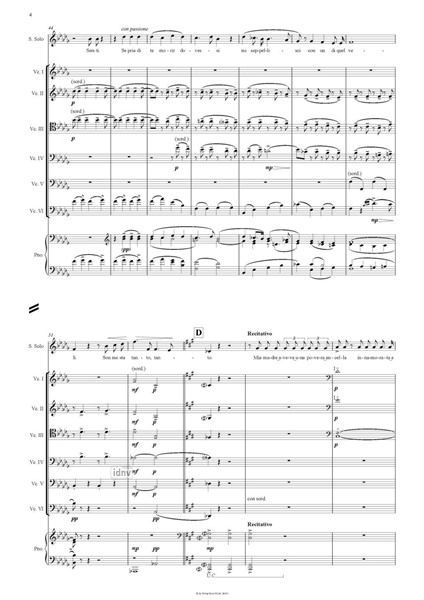
Description
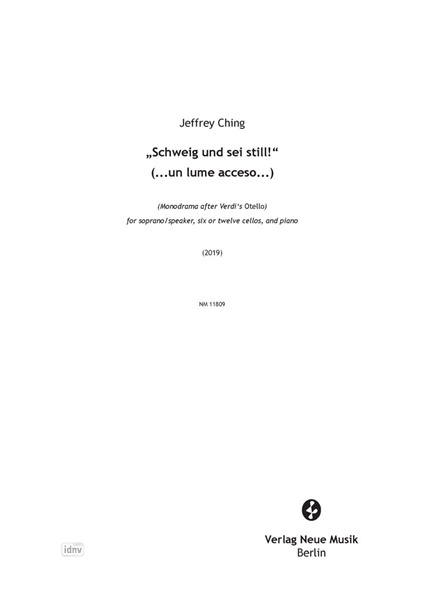
`Schweig und sei still!` is Wolf Henrich Graf von Baudissin’s rendering (1832) of Shakespeare’s `Peace, and be still`- the words with which Othello brutally silences in advance all Desdemona’s attempts to prove her innocence. Significantly, in Verdi’s “Otello” (1879-87) this pivotal sentence is missing from Boito’s text, for soon after Desdemona’s ‘Willow Song’ and ‘Ave Maria’, the leap from accusation to murder proceeds with terrifying rrapidity. In the second chapter of “Wenn du geredet hättest, Desdemona” (1983), the German novelist Christine Brückner fantasises about what Desdemona could have done to save herself had Othello only granted her an uninterrupted quarter of an hour in which to speak. In fact Rossini had already anticipated just such a denouement when he rewrote his “Otello” of 1816 for its Roman premiere in 1820.
All these miscellaneous elements from literary and musical history seem united in a common Shakespearean origin, and are yet fundamentally at odds with one another. Brückner’s imaginary ‘monologue’ for Desdemona is really a dialogue with Othello, who responds inwardly to her words with alternating submission and resistance while he (and not Desdemona) remains outwardly ‘schweig und still’ for fifteen minutes. These fifteen minutes are roughly equal in duration to Verdi’s music for Desdemona’s ‘Willow song’ and ‘Ave Maria’, but there any resemblance between the two quarter-hours ends. Verdi’s heroine sings exquisitely, first to a nearly mute attendant, and then in solitary prayer to the Virgin Mary. Coming face to face afterwards with Otello’s insensate rage, she finds none of her virtue or grace of any avail in calming him, though her very life depend on it. By contrast Brückner’s heroine is confident both of a final exoneration by the plain facts, but above all of her sexual power over her husband, which one can predict she will exploit time and again to save both her life and her marriage. This more ‘matriarchal’ Desdemona of Brückner’s (and Rossini’s) is thus simultaneously modern and archaic, and certainly more sportive and subtle than the rather passive Desdemona of Shakespeare-von Baudissin-Boito.
To gather these Desdemonas into one work and confront them with each other, the soprano Kirsten Borchard and I have devised a continuous ‘monodrama’, half sung, half spoken, for her to perform with an ensemble of several cellos and piano.
[…]