






Description
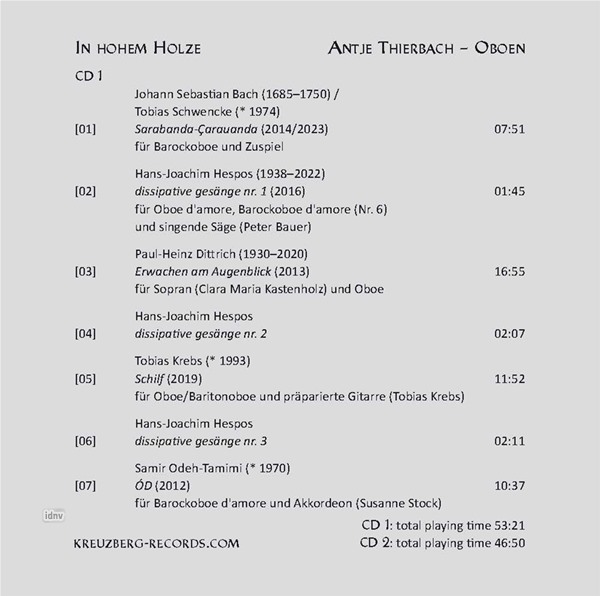
Content CD1
Johann Sebastian Bach / Tobias Schwencke
1. Sarabanda-Carauanda für Barockoboe und Zuspiel
Hans-Joachim Hespos
2. dissipative gesänge nr. 1 für Oboe d’amore, Barockoboe d’amore (Nr. 6) und singende Säge (Peter Bauer)
Paul-Heinz Dittrich
3. Erwachen am Augenblick für Sopran (Clara Maria Kastenholz) und Oboe
Hans-Joachim Hespos
4. dissipative gesänge nr. 2
Tobias Krebs
5. Schilf für Oboe/Baritonoboe und präparierte Gitarre (Tobias Krebs)
Hans-Joachim Hespos
6. dissipative gesänge nr. 3
Samir Odeh-Tamimi
7. ÓD für Barockoboe d’amore und Akkordeon (Susanne Stock)
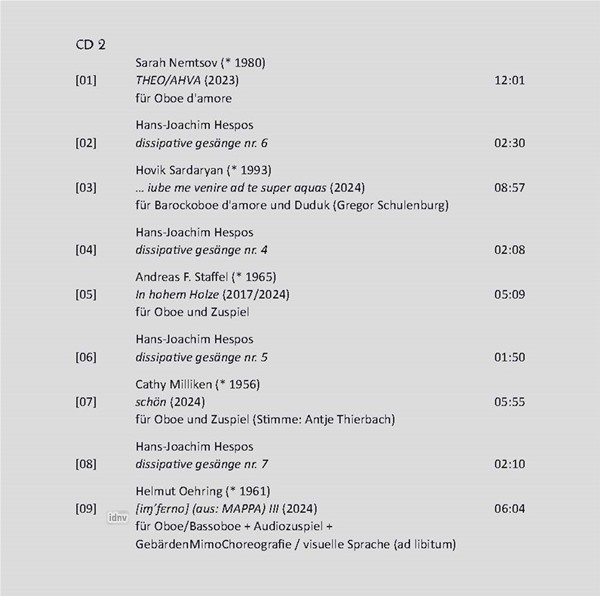
Content CD2
Sarah Nemtsov
1. THEO/AHVA für Oboe d’amore
Hans-Joachim Hespos
2. dissipative gesänge nr. 6
Hovik Sardaryan
3. …iube me venire ad te super aquas für Barockoboe d’amore und Duduk (Gregor Schulenburg)
Hans-Joachim Hespos
4. dissipative gesänge nr. 4
Andreas F. Staffel
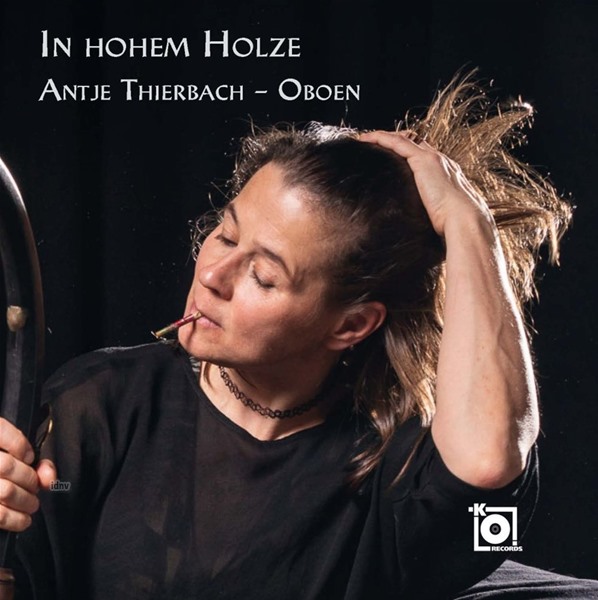
5. in hohem Holze für Oboe und Zuspiel
Hans-Joachim Hespos
6. dissipative gesänge nr. 5
Cathy Milliken
7. schön für Oboe und Zuspiel (Stimme: Antje Thierbach)
Hans-Joachim Hespos
8. dissipative gesänge nr. 7
Helmut Oehring
9. [im’ferno] (aus: MAPPA) III für Oboe/Bassoboe + Audiospiel + GebärdenMimoChoreografie / visuelle Sprache (ad libitum)
Hautbois, the high woodwind, hoboe, the oboe.
Singular?
In the conventional symphony orchestra, the oboe is unique primarily because of its sound;
its role is clear, unmistakable in its cantabile quality akin to the human voice, but this also
limits its expressive possibilities. Gustav Mahler, for example, who wrote wonderful solos for the oboe, played this role, but also prophesied its extinction for precisely this reason. An overly pure love affair?
The oboe was first built in France at the end of the 17th century and has been continuously
developed ever since. Every era has had its instruments and its music, contemporary music.
It wasn’t called that; it was simply taken for granted. Only in the last 150 years or so have we
increasingly listened to and played music from earlier times.
While for composers the year 1945, the end of the catastrophe of the World Wars, marked a turning point, for performers of so-called classical music, new and powerful impulses came more from the 1968 student movement of the last century. The why and how of performing primarily music from bygone eras were called into question. Disturbing interpretive approaches, which conceived of music not as cultivated euphony but as a form of sonic discourse and provocation, countered the constant reproduction and the slide into mere
artrifice with productive alternatives.
Source study, research into historical instruments, the role of composers and performers in different eras, and the function of music in past and present cultures moved into focus. Less
hierarchically structured ensembles for early and contemporary music emerged.
More than half a century later, these ensembles, often in their second and third generations,
continue to exist alongside state orchestras, and have achieved a high degree of standardization.
Over the decades of my musical career, I’ve had the privilege of collaborating with artists and
ensembles of diverse styles. My family of oboes has grown, and my experience working with
living composers, improvisational musicians, and theater musicians has shaped my perspective on music from earlier eras. The interest could be described as archaeological.
The compositions in this release were written for me or premiered by me; the instruments were selected from a conceptual/compositional point of view. The oboes sometimes sound entirely on their own, sometimes with backing tracks or very different partners, thus revealing a wide range of facets of their characters. This isn’t about feasibility studies; extended playing possibilities are entirely in service of musical ideas. “Singing is the foundation of music in all things”, wrote Telemann, and that is also my credo, albeit a somewhat paradoxical one.
In this family context, the singularity of the oboe becomes relative. The intense dialogue
with soprano, singing saw, duduk, prepared guitar, techno beats, accordion, sound effects,
with itself, and with recordings of my own voice allows it to transcend itself. Its identity becomes permeable in time and space.
Antje Thierbach