





Description
Preface
[…]
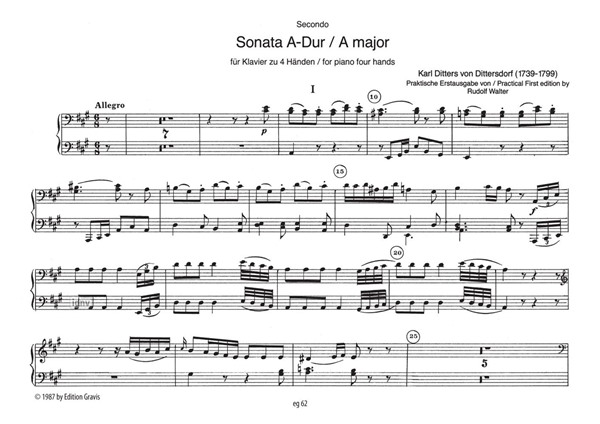
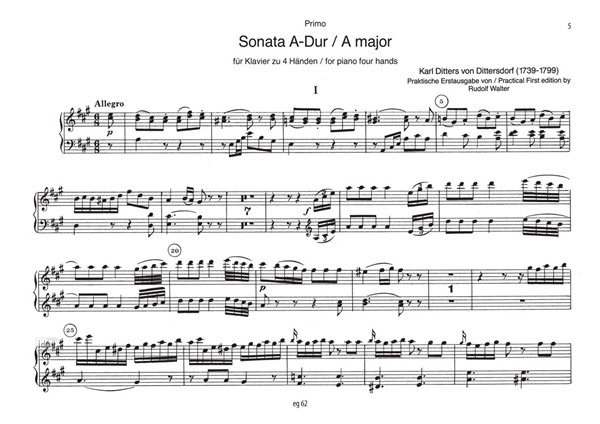
Similarly to Mozart’s four-hand piano sonatas, the present composition is also in three movements. The piece opens with an Allegro in sonata form, which is followed by a song-like Adagio as middle section. A variation movement closes the work. Besides having both partners play together – partly in the early style in which the secondo performer plays the part of the primo performer one octave lower, which leads to the crossing of the middle hands – Dittersdorf also alternates the parts, like in Haydn’s “il maestro e lo scolare”. This sonata is stylistically related to those of J. C. Bach, and despite several third-related harmonic progressions, its expressive character reflects the Rococo style.
Rudolf Walter