









Description
Kammermusik V is at the end of a series of ensemble pieces that have not unsignificantly contributed or marked various stations of my compositorical development. Only after “Kammermusik IV” I became aware of a certain logic of succession and an inherent type of compositorical problems in all five pieces. In other words, the series has never been planned like that from its beginning in 1989. Furthermore, “Kammermusik II” from 1991 is, from my point of view, a kind of premonition of musical but also expressive features that – because of various reasons – I did not go into more deeper until the early years of the new millenium. “Kammermusik I” was revised by myself completely in 2006. A revision of my own works has never been done so far, except certain changes in instrumentation or dynamics which cannot be regarded as real revisions (read: change in real substance). Rather I would have withdrawn a piece that I could not accept anymore. So far, this has happened in two cases.
With “Kammermusik I” a withdrawal seemed not to be convenient, because the basic substance of the composition was still ideal for the opening of the series, and even a substantial revision would not change the main idea too much. So, for me it still is a piece from 1989, revised in 2006!
While “Kammermusik I and III” are mainly signified by music-technical aspects or problems of psychoacoustic perception, “Kammermusik II, IV and V” also own increasingly personal “issues” of me as a human being and concerned artist. But as in all similar cases, these elements are transformed in such a way, that they are somewhat “private and hidden heritage” and only represent a certain catalytic function for the composition.
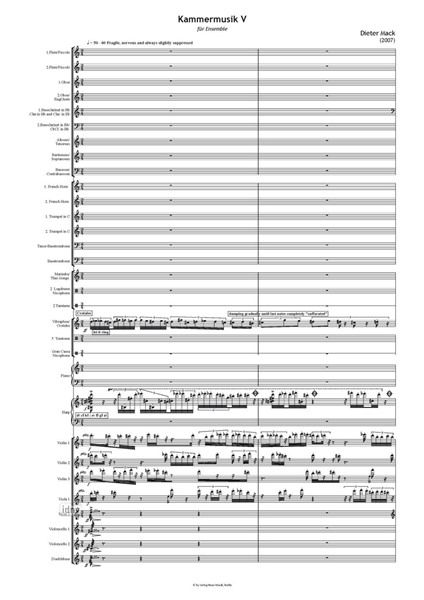
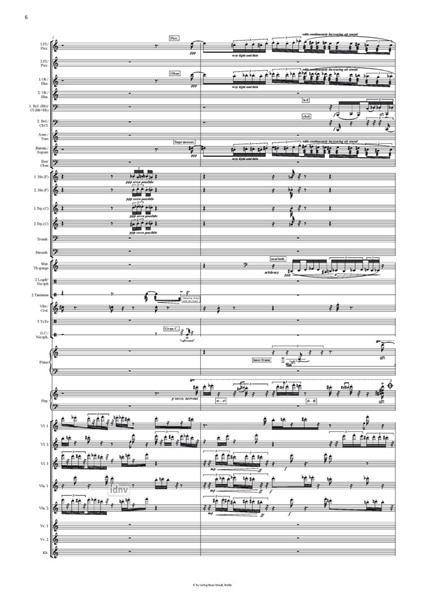
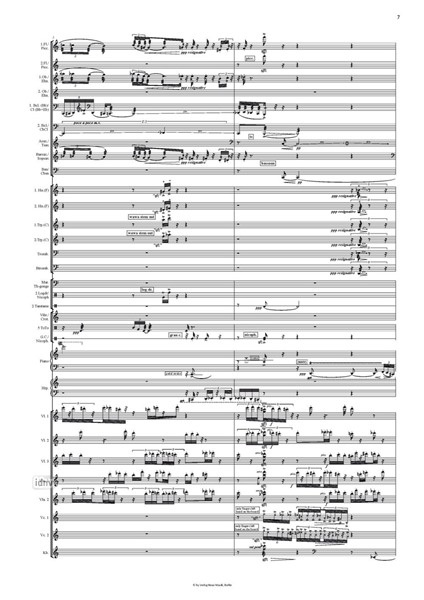
Seen from its instrumentation, “Kammermusik V” is the biggest composition of the series with 27 players, and therefore may be better called a chamber orchestra piece. However, the peculiar way of composition, the individual approach to every instrument or instrumental groups urged me to keep the title “Kammermusik”.
In “Kammermusik V”, mainly psychological elements within groups, including aspects of hierarchy play an important role. Musical “individuals” (that could also be manifested by groups) are in a current flow and discourse of “sound-spacial” conflicts. Between the extremes “complete melting together” and “complete isolation”, the music moves in an onging “Wechselbad” of different stadiums of the respective relationships or non-relationships.
By that the composition is nonetheless a mirror of our actual inter-human and inter-cultural communication conflict that moves equally between such extremes as speechlessness, falling silent, superficiality, and arbitrariness until an overload of information and triggers which perhaps are in fact the sources of that speechlessness. By that the circle is closing in.
I do not want to paint a dark picture of the final Armageddon. However I would like to point to the urgent necessity of the ongoing cultivation of the direct human contact and interrelationship as something too fundamental to mankind to be forgotten, far beyond any SMS, mobile phones, Email and other disturbing tools of mutual alienation.