









Description
Nöck (Swedish: näcken, Norwegian: nøkken), the Nordic counterpart of the more familiar mermaid, lives in rivers, streams, and brooks according to Scandinavian mythology. Similar to the Lorelei, he lures people into the deep water, though what happens to those abducted there remains a mystery, as no one has ever returned. Unlike the mermaid, the Nock does not lure with song, but with his violin playing.
His natural form is that of a naked young man sitting on a stone in the water, playing the fiddle. However, he also possesses the ability to transform himself into almost any shape that aids his enchantment. Thus, he sometimes appears as a pretty girl, a brave young man, a playful child, an old man seeking help, or – one of his most frequent forms – a lively foal. Despite all this, he has only one goal: to drag those who fall under his spell into the depths of the water.
At the same time, mythology also recounts that he warned people of storms and rescued them from the floods, so that by nature he is not truly evil, but rather lonely, capricious, and unpredictable, endowed with an untamed mystical energy alien to humankind.
He also passes on the art of his violin playing to people, which, however, is fraught with great risk for them: A minstrel who has learned is art from Nöck, once he starts playing, may not be able to stop and play himself into such a frenzy that he dies, just as this fatal force can also be transferred to thos who dance to his melodies, so that they literally dance themselves to death.
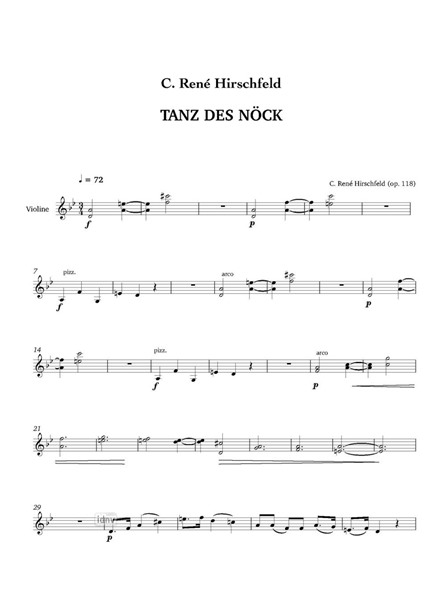
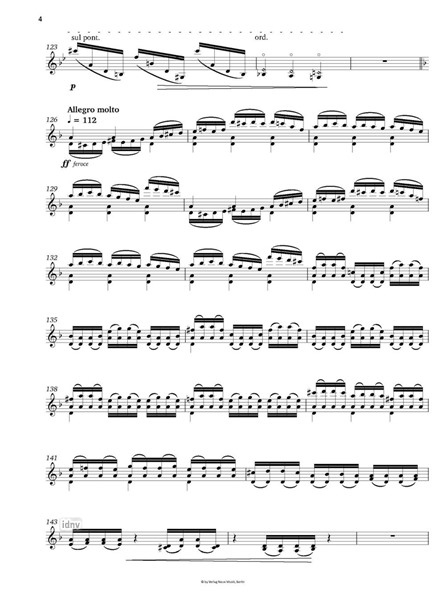
“Tanz des Möck” (Dance of the Water Spirit) “Nöck’s Dance” was composed in 2009 as an almost classically structured set of variations on the Nordic folk melody “Näckens Polska”, with the individual variations flowing seamlessly into one another and not meant to be understood separately. However, the piece does not begin with the theme, but with an abstraction or a variation of it in the form of a reduction to the most essential tonal characteristics, to which it returns at the end.