









Description
ON THE BENEFIT OF LETTING GO (1981–1984)
after Meister Eckhart
Meister Eckhart has engaged me for half a century now. Prompted by my first trips to the USA in the seventies to collect interviews for Desert Plants (conversations with 23 american musicians), I encountered Eckhart again while reading Cage’s Diaries & Essays, and came to understand his thought as a bridge spanning from Cage to Zen and back to Europe. Back in Cologne, I visited the Meister Eckhart Institute, where I met Josef Quint, the editor of the writings, and read in the Middle High German editions. Herbert Henck eventually gave me an edition for my birthday. At the same time, I studied Gregorian chant and attempted to translate these experiences into a first piece on Eckhart, Gelassenheit (Releasement / Letting-be), for alto and two guitars. I also attempted to depict the experience of enlightenment described as the „Scintilla animae“ (the spark of the soul). But I soon realized that the somewhat strained volition of this piece fell far short of redeeming what Eckhart aims for. It
became, so to speak, Gelassenheit in the form of a command: „Therefore begin first with yourself and let go of yourself!“ The piano trio Ephemer emerged as the next engagement with Meister Eckhart. Through this, I understood that Eckhart’s thought cannot be presented programmatically in any way, but must instead enter directly into the treatment of the material — which means dissolving the idea-laden nature of Meister Eckhart’s words into sound, in order to initiate a process that ultimately dissolves the words themselves.
Much like how in Zen one should arrive at the point of no longer wanting or needing to speak about Zen, because it permeates everyday life to such an extent that one no longer notices how one lives Zen, I attempted to penetrate Meister Eckhart’s thought in order to integrate it into my thinking about music. I now wanted, without programmatic self-prompting, to dissolve my attachments to the past. Reaching the point of no longer occupying these very phenomena, but allowing them to take shape in their essential authenticity, comes close to what „non-attachment“ means in Zen Buddhism and precisely
what „Gelassenheit“ means in Meister Eckhart.
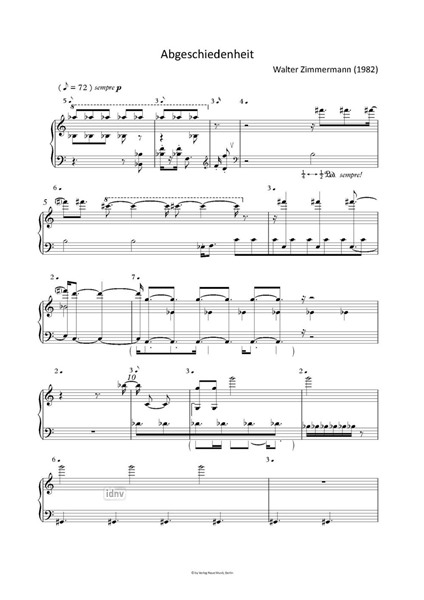
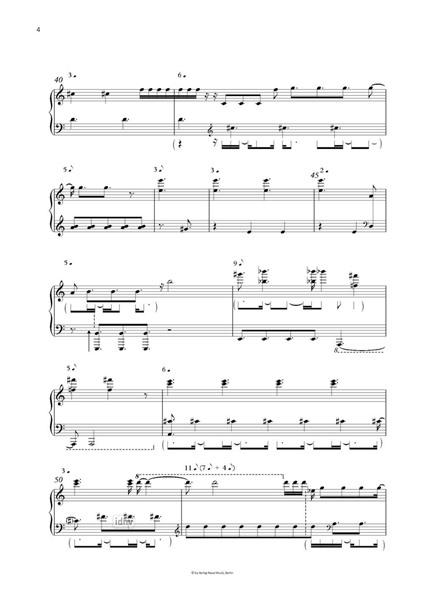
Thus, this process first took its true shape in the piano piece Abgeschiedenheit (Detachment). The sonic space opens up even further, leading to the actual work of dissolution in the piece Lösung (Release / Dissolution) for trio basso, which ends in non-sounding. After that, all that remained was to dissolve the texts of Meister Eckhart themselves — which gave path and
direction to the pieces. Thus emerged Selbstvergessen (Self-Forgetting) for speaking/singing voices and obligato sounds, which was performed in 1992 in NYC with David Tudor and ensemble as music for the Merce Cunningham Dance Company. When asked what he would recommend to young German composers, John Cage replied in Bremen in 1982: „Read Meister Eckhart.“ This I did.