









Description
Introduction
To compose for instruments of another culture (and originally of a completely different music as well) is not an easy task. On the one hand, one might even refuse only to think about it; and on the other hand, a composer may just try to compose in the original musical language of that culture in question. Both extremes seem not to be the ultimate solution, but the first position seems to me more understandable compared with the second, although this might be a typical European position.
As a composer who has lived quite a while in the local surroundings of Balinese and Sundanese music, I try to find another solution, to compose for instruments of a foreign culture. The artistic challenge of such a task may be seen in the fact that the instruments have a peculiar character (especially the tuning), timbre and technique but also something that goes beyond the local musical impacts of their respective origin. And it is especially this tension between these two poles that makes the compositorical process a real challenge. How can I compose an autonomous music (based on my cultural consciousness) using instruments from another culture, without misusing those instruments? While the latter is always a subjective decision to a certain degree (is playing the violin on the edge of its wooden frame a misuse of the Western violin or not?), the first is more due to a quite non-compromising attitude in composing as a whole.
After a first composition for Balinese gamelan in 1997, this is my second one now for Sundanese instruments, and I would like to thank the musicians from the Evergreen Gamelan Club in Toronto, especially Andrew Timar, for their support in preparing this piece.
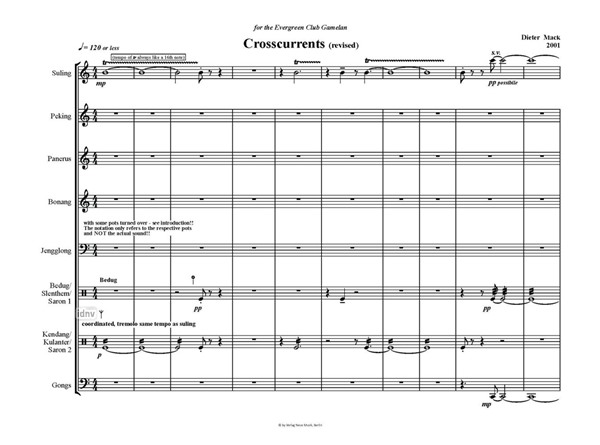
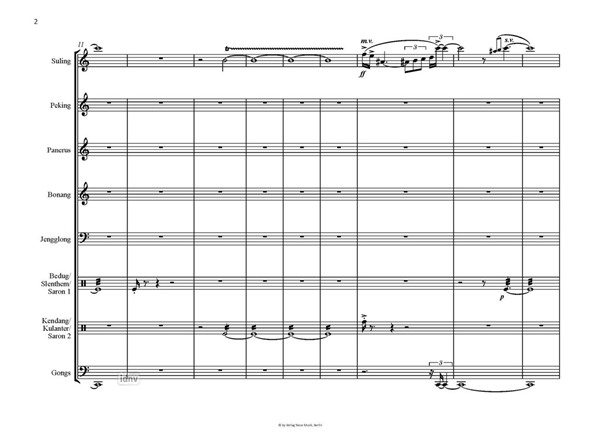
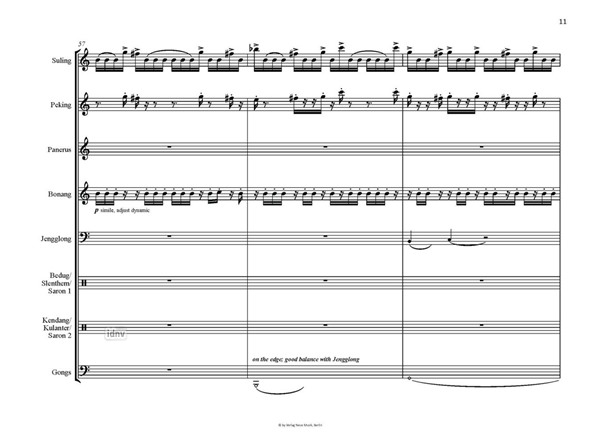
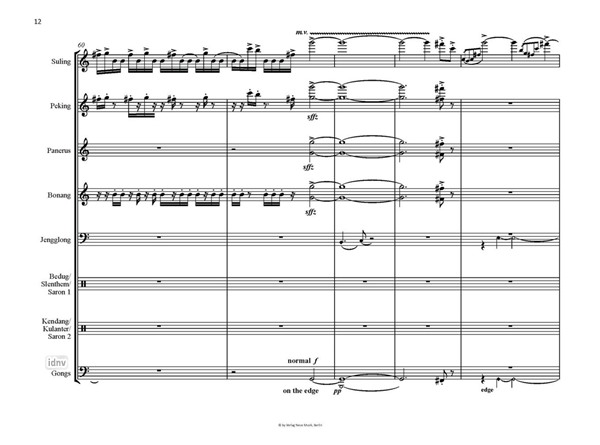
Although the piece has more solistic aspects (suling!) as most of my other music, the collective group consciousness is a main feature of the musical expression, coming out only during the process of realisation. In others words, one of the main elements of this music may only begin to be felt after a comparably long phase of preparational rehearsals. If therefore the score looks quite complicated (and sometimes probably even impossible! – f.e. the tempo of certain passages), it is up to the players to find a solution that is convenient for everyone. This means that certain deviations are possible due to the collective concept, but only after every player has managed his respective part. Therefore at least in the beginning it is inevitable that every player has the whole score to become aware of his individual position in the framework of the every textural situation.