





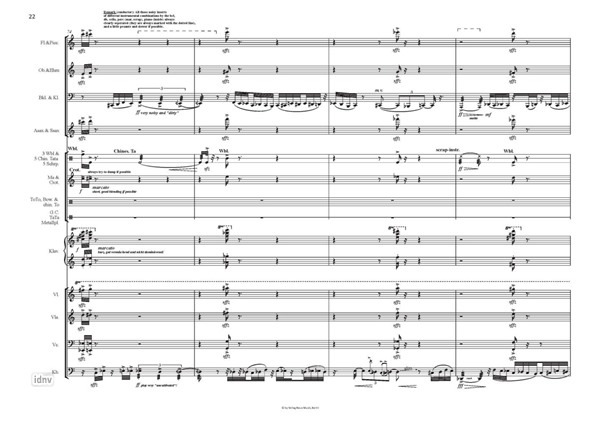
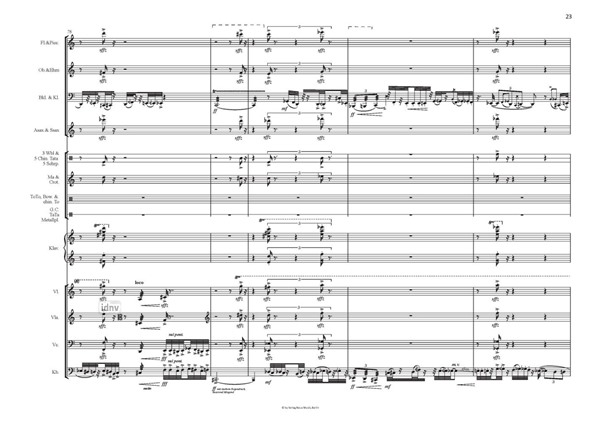
Description
Basic Comments
Together with the previously composed duet „Selisih“ for alto- and baritone saxophone, „Kammermusik III“ marks a new attempt in my music. In most of my works from the 1990s, I was occupied with certain questions of musical communication, interaction, and the marking (structuralizing) of frameworks (colotomic structures). Nowadays I have started to become more interested in individual expressions. With other words, aspects with an analogy to language/speech in a single voice or part are of higher importance. However, this has less to do with the overall structural and formal devices of the composition. The focus is on individual gestures of expression, that I would like to call “personal dialects”. This leads partly to a signifi cantly higher presence of soloist elements by the respective instruments/players (here mainly the bass clarinet, the alto sax, percussion and the partly the double bass – see below). Although these “personal dialects” get into dialoguelike relations as well, it is the individual that stands in the foreground. Only at some crucial spots, moments or situations, the various voices merge towards a more collective character and “behavior”.
No wonder that this leads to another way of writing, where microtonal lines and extreme ranges play an important role. Therefore microtones are less an element of an extended scale system. They are more regarded as a tool in order to achieve a more differentiated articulation of each musical moment and also to support a more physical character of the
musical expression. Such forms of articulation are common practice for example in the woodwind and string playing in most Asian music cultures. However, in my case here it has nothing to do with a cultural adaption of any sort. It is completely connected with a higher degree of differenttation of an autonomous playing technique that may appear
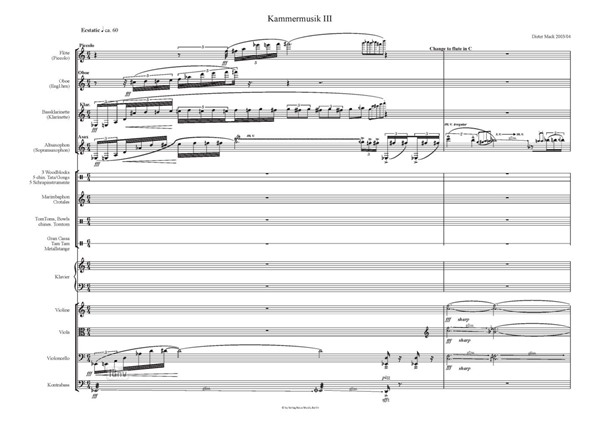
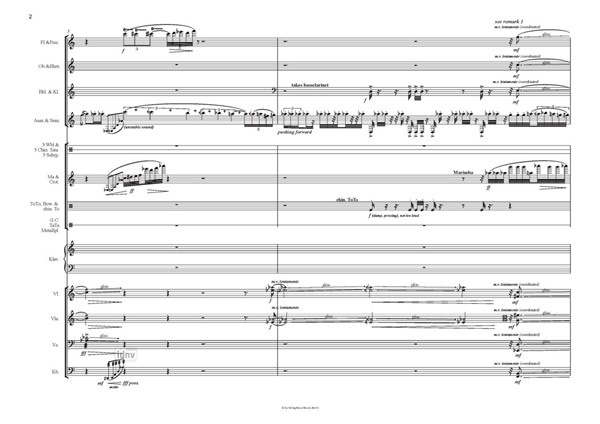
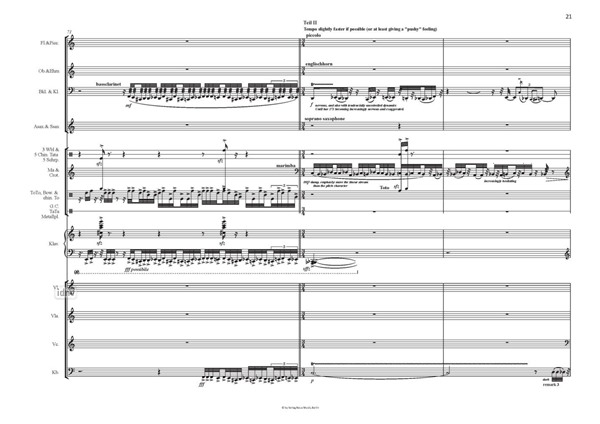
as well in various other cultures. Only in a few cases (mixture-like chord progressions) a precise realization of quarter-tones is essential. It is always quite clear in the score itself.
The situation is similar in regard to all forms of glissando and vibrato. While some glissandi are clearly defined, most of the end-glissandi are not. In these cases, the intention is a certain “pressing higher” or “falling down” of the respective pitch in a microtonal range. While the latter is more attached to an expression of relaxation or even resignation, the
first own resembles a certain tension that is targeted to “something that ultimately cannot be reached”. All forms of vibrato should be precisely taken care of. If there is no special notation, the traditional way of playing is intended.