








Description
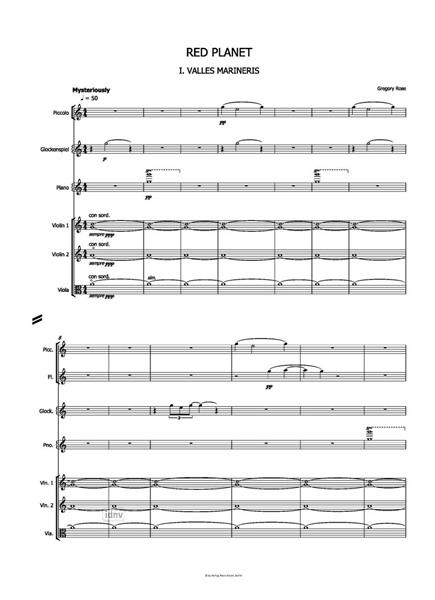
Movement I: VALLES MARINERIS (Mysteriously)
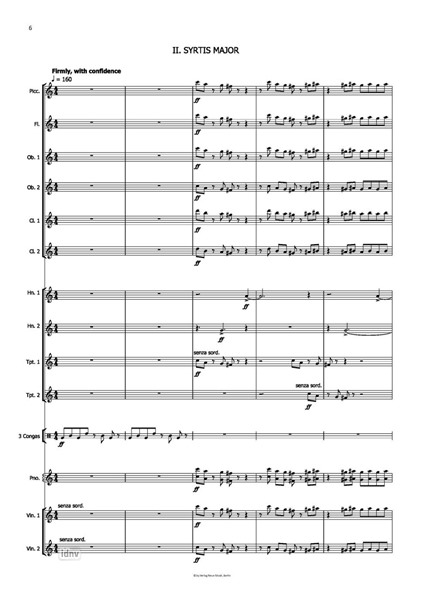
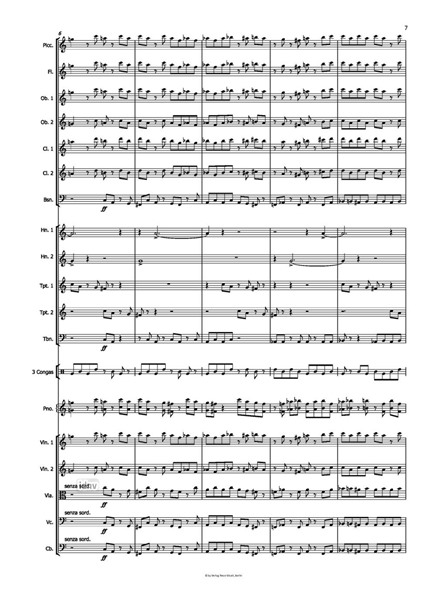
Movement II: SYRTIS MAJOR (Firmly, with confi dence)
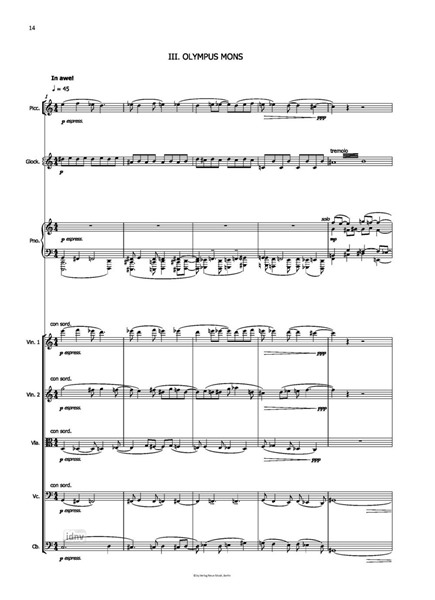
Movement III: OLYMPUS MONS (In awe!)
Movement IV: SIRENUM FOSSAE (Confi dently)
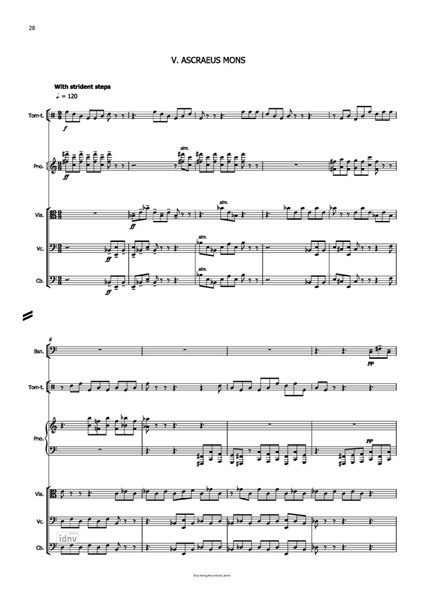
Movement V: ASCRAEUS MONS (With strident steps)
Red Planet was inspired by the spectacular images of Mars that have appeared through the exploratory work carried out by a succession of mainly US spacecraft over the past fifty years or so. The vastness of the mountains and valleys on the planet is hard for us to conceive, as is its inclement weather patterns. Mars is, simply, unimaginable. Red Planet attempts to reflect some aspects of the planet through contrasting musical scenes. Mars is the fourth planet from the Sun and the second smallest planet in the Solar System and is named after the Roman god of war. It is often described as the „Red Planet“ because the iron oxide prevalent on its surface gives it a reddish appearance. Mars is a terrestrial planet with a thin atmosphere, having surface features reminiscent both of the impact craters of the Moon and the volcanoes, valleys, deserts, and polar ice caps of Earth.
The large canyon, Valles Marineris has a length of 4,000 kilometres and a depth of up to 7 kilometres. Its length is equivalent to that of Europe and extends across one-fifth the circumference of Mars. By comparison, the Grand Canyon on Earth is only 446 kilometres long and nearly 2 kilometres deep.
The largest dark feature seen from Earth, Syrtis Major Planum, is a „dark spot“ located in the boundary between the northern lowlands and southern highlands of Mars just west of the impact basin Isidis. Later topographical maps indicated that Syrtis Major includes a high-altitude bulge rising to 6 kilometres (3.7 miles). The dark colour comes from the basaltic volcanic rock of the region and the relative lack of dust.
The shield volcano, Olympus Mons (Mount Olympus) is an extinct volcano in the vast upland region Tharsis, which contains several other large volcanoes. At 22 kilometres Olympus Mons is the highest mountain on Mars and is nearly three times the height of Mount Everest, which in comparison stands at just over 8.8 kilometres.
Sirenum Fossae is a trough in the Memnonia quadrangle of Mars and is 2,735 kilometres long. It is believed to have formed by movement along a pair of faults, causing a centre section to drop down, and extends more than 2500 kilometres to the southwest of the Tharsis volcanic region, which houses Olympus Mons.
Ascraeus Mons is the tallest shield volcano located in the Tharsis region of the planet. It was discovered by the Mariner 9 spacecraft in 1971, and was originally called North Spot, because it was the northernmost of only four spots visible on the surface due to a global dust storm that was then enshrouding the planet.
As the dust cleared, the spots were revealed to be extremely tall volcanoes whose summits had projected above the dust-laden, lower atmosphere. It is roughly 480 kilometres in diameter and is the second highest mountain on Mars after Olympus Mons, with a summit elevation of 18.1 kilometres.