









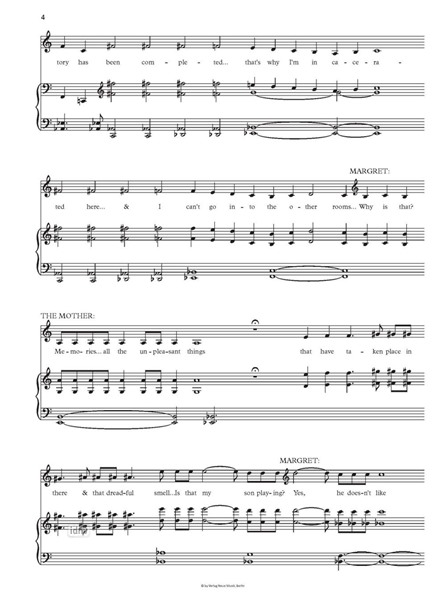
Description
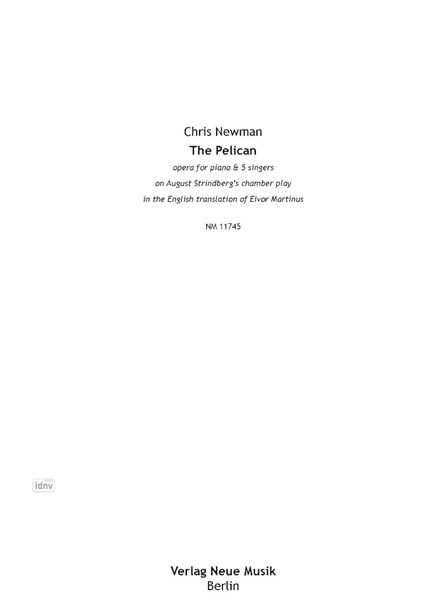
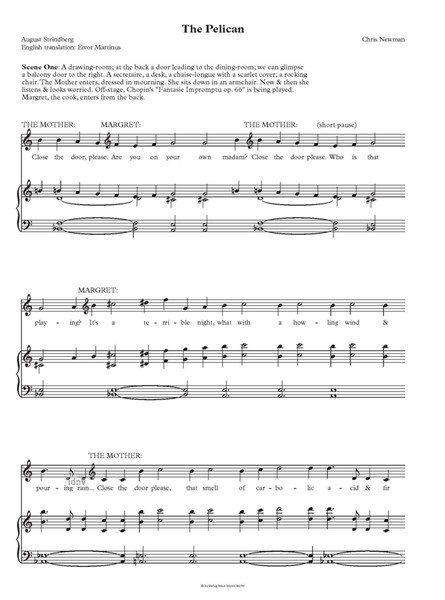
This piece is an opera for piano & 5 singers (1 soprano, 2 mezzo-sopranos, 1 tenor & 1 baritone), a complete setting of August Strindberg’s chamber play The Pelican, written for his own intimate theatre in Stockholm in 1908, translated by Eivor Martinus. The 5 characters involved are: THE MOTHER (Elise, widow), (around 50) (mezzo-soprano), THE SON (Fredrik, law student) (around 22), (tenor), THE DAUGHTER (Gerda) (20) (soprano), THE SON-IN-LAW
(Axel, married to Gerda) (around 35?) (baritone), MARGRET (servant) (55-60) (mezzo-soprano) – although these ages are of course only a rough guideline for the ages of the singers. On viewing this score it will become immediately noticeable that many of Strindberg’s stage-instructions are at loggerheads with the straight-through non-descriptive method of the word setting, which renders them useless or counterproductive. A good example of this can be
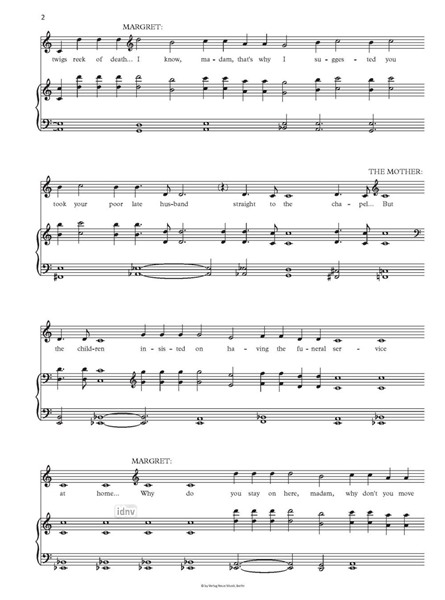
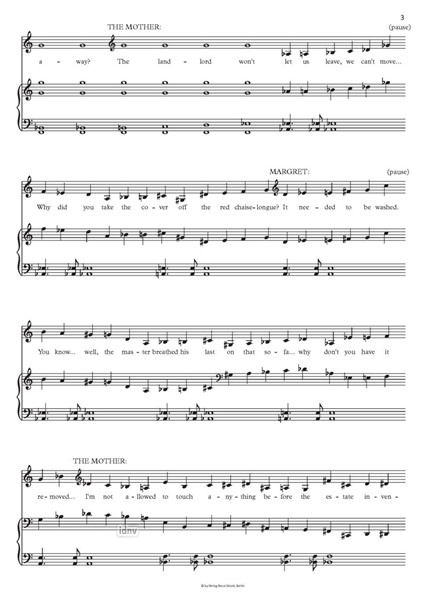
found in Strindberg’s introduction of piano music at the beginning of 3 of his 4 scenes – it is as if Strindberg’s presence of a piano had taken over the whole of this ‘opera’. It was given a chance, & it took it. It should be said that the stage-instructions should be carried out whenever possible, & that Strindberg should be represented as realistically as possible, but on no account should the music be broken in order to do so; the music (apart from the break on p. 68 for an interval of conventional length) should be continuous. The attempt to reconcile the setting of the text as a continuous flow with the realism of Strindberg’s stage-instructions produces the tension of relationship per se, which is central to this piece (& much of my work in general). The text ‘left over’ after the music ends should be spoken naturalistically rather than rhythmically.
The piano should not be situated on the stage, but a second (mini-)stage could be constructed for this purpose. The Pelican is dedicated to John McAlpine, Norbert Prangenberg & Peter Schmersal. The dynamic is basically f throughout and the tempo quarter = 120.
C. N.