








Description
Writing a percussion concert seems to be attractive and “easy” at a first glance. However, if one is going deeper into the subject, and if one attempts to avoid a more popular “banging battle-style”, it may become a real challenge. Another problem is the unlimited amount of potential percussion instruments. It becomes even more critical if the soloist is positioned in front of the orchestra. This appeared to be a real problem in my first concert “Vuh” from 2000. Therefore I sat down with Johannes Fischer quite extensively to discuss
the set-up and the instrumental limitations. Furthermore his style of playing percussion differs completely from the previous soloist for whom I wrote “Vuh”.
Although the marimbaphone is almost “over-used” in contemporary percussion music, it became the central instrument of the soloist in “Wooden”. In order to give the instrument a unique character, it was extended with pieces of wood, tuned in quarter-tones. The additional keys are put in two rows above the main keys. It is then crucial that the soloist tries to adjust the two sound qualities of the original marimbaphone keys and the pieces of wood (ebony), because the latter do not have a resonator. After some experiments together with Johannes Fischer, we found a convenient solution. The special character of this main instrument is also the reason for the title “Wooden”. With four big log-drums, seven tom-toms and three wooden tom-toms, the set-up of the soloist is complete and can easily be positioned in front of the orchestra without covering the other instruments. Metal instruments (which are so significant in my percussion parts during the last 5 – 7 years) are completely avoided, except in the orchestral percussion.
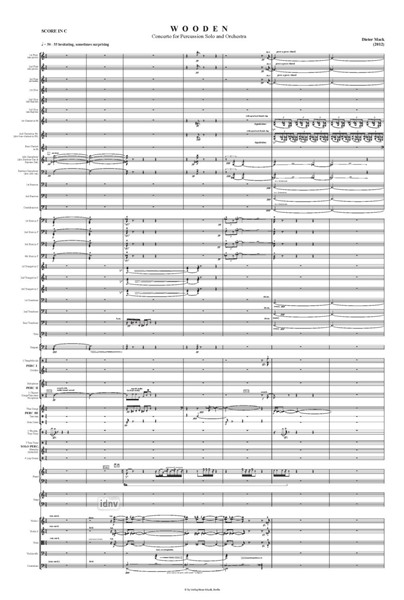
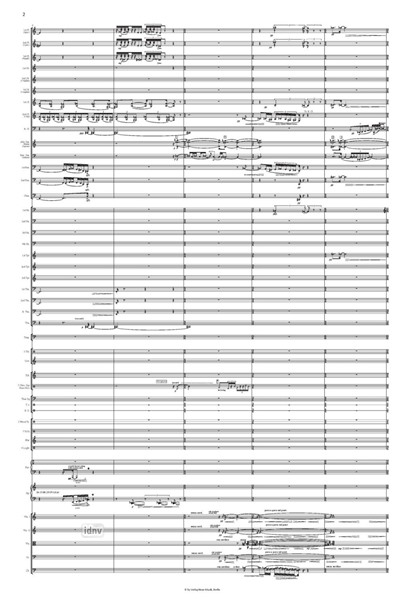
“Wooden” deals with various roles of the soloist ranging from marking structurally the music played by the orchestra, up to some, comparably quite short solo passages. The main body of the pieces puts the soloist in multiple combinations with other instruments. As a whole it creates a more chamber-music-like atmosphere.
Dieter Mack