









Beschreibung
“De Materia Subtilis et Complexa”
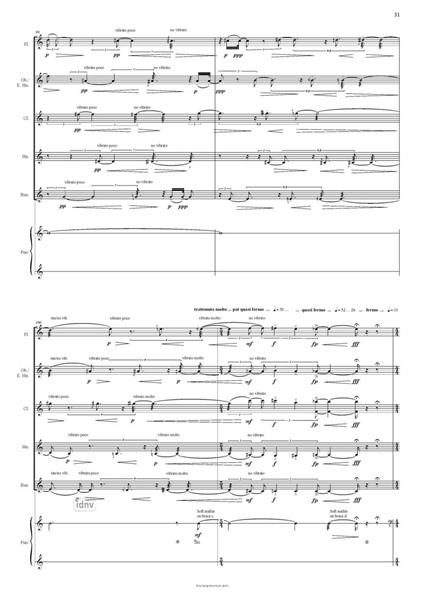
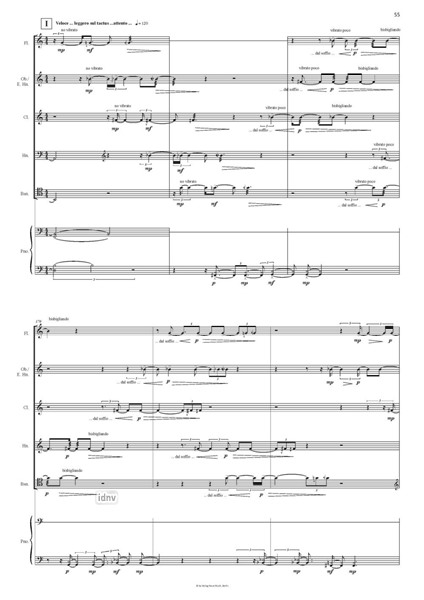
The project of constructing a work inspired by the musical movement called “Ars subtilior” came to me after reading some articles and research about the notation complexities and practice difficulties of the “musica secundum imaginationem” .
I quickly realized that my love for this art, which was forgotten until the middle of the twelth century, had driven me to discover some interesting similarities between my work and the investigations of artists as Filippo da Caserta and Philippe De Vitry.
The repertoire of the Ars Subtilior is cut off from the canonic body of “great music” by what Hans Heinrich Eggebrecht calls “gaps in reception” and this directly reminded me of the existing ‘iatus’ between the production of most art music of today , the audience reaction to it and disturbing winds of reactionary conservatism.
As a label for the period, the word ‘ars’ emphasizes the continuity with the repertoire of the ‘ars nova’, in my poly-cycle called ‘De Materia’ the title underlines a connection to a historical moment in which the duty of the artist and the philosopher was to see in every sign the reflection of another sign. Today as yesterday the notion of ‘subtilitas’ seems first to have emerged from an authentic necessity to create and discover “simpatie” in the matter. But subtilitas itself remains ill defined as a historical aesthetic category; often it seems to be equated wholesale with the complexity of the music, therefore an attempt
to understand subtilitas and its possible role in the musical discourse of our contemporaneity seemed to me an excellent opportunity for an introspection and further introspective journey into “De Materia”.
Jacques of Liège, in his controversial Speculum musicae, Book VII, presents subtlety and difficulty side by side as (apparent) qualities of “the modern art”, associating these qualities with a proliferation of notational forms at the possible damage of an ideal musical perfection.
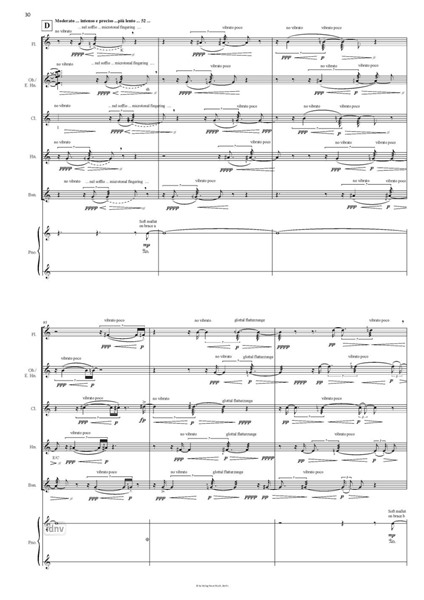
The word subtilitas is closely related with the emphasis placed on craft mastery. Isidore says that the effects of colours in the renaissance were cultivated at first ’so that the very best of skilled work [summae subtilitatis] might be created‘. My research into the domain and colour of the multiphonics of wind instruments has been exactly this: a pre-compositional journey into new timbers where a whole set of ‚qualia’ have been investigated and discovered.
The word subtile (Latin subtilis) is not an aesthetic word per se, but a valuation of deeply skilled and learned craftsmanship, in the same conceptual category as Middle English ‚mystery‘, meaning ‚the skills and knowledge particular to a learned craft‘, a master’s craft secrets. Vitruvius used various forms of subtilis often to mean ‚thin, fine‘, but also as a positive judgment of refined artusanry. Also in my work subtilis becomes a value of fine craft skills and marvellous technical mastery, prompting in the perceiver the question ‚How is this produced, obtained?‘ as well as the judgment ‚How charming and subtle‘.
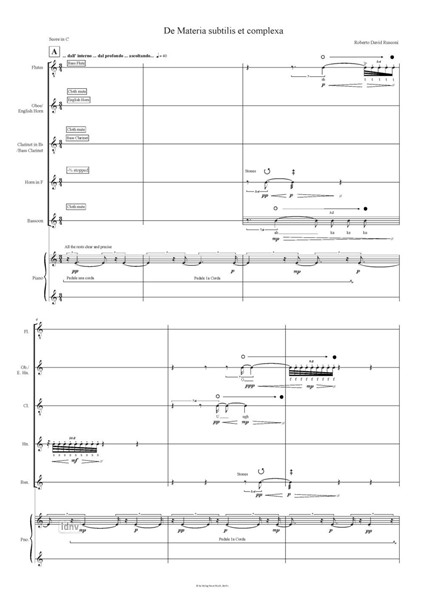
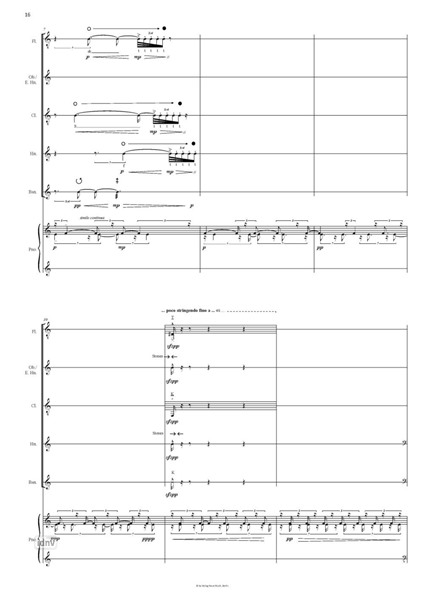
Subtilis in medieval Latin, always has to do with fine workmanship and design, especially demonstrated in multicoloured, illusionistic effects. These are, of course, compatible with the aesthetic of trompe l’oeil illusion, which place other techniques for the piano and the “breathed instruments” at the poetical and structural core of this work.
In this work I suggest subtilis as something intricate (complex) but delicate, a quality imparted not only by to the notated inscription of the music, but even more to the perceptive attitude of the performer and the listener. Even if subtilitas is to be conceived as a property of the musical text, I tried to structurally and poetically develop a correlation in the sonic environment.
The pivotal point of this creation has been not to base the understanding of subtilitas on an untenably rigid dichotomy between written and sounding music; instead to connect it with the very relationship between these two pursuing the very same attitude of the old maestri with new tools, aiming at new destinations for new travellers.
Roberto David Rusconi