









Description
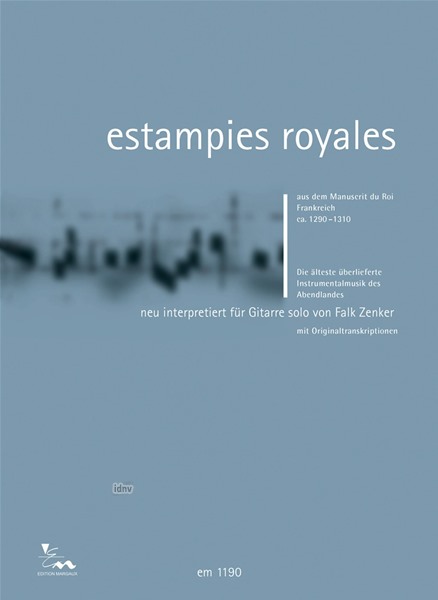
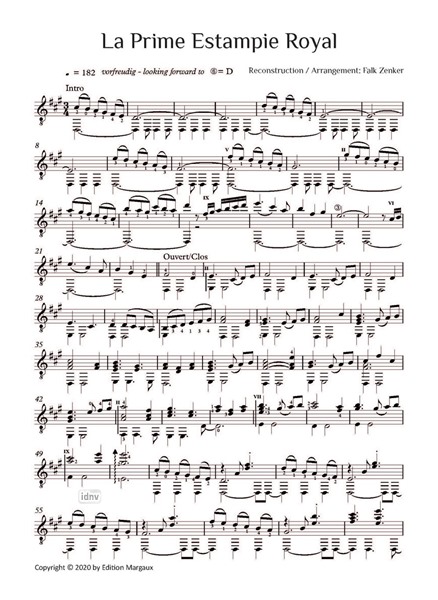
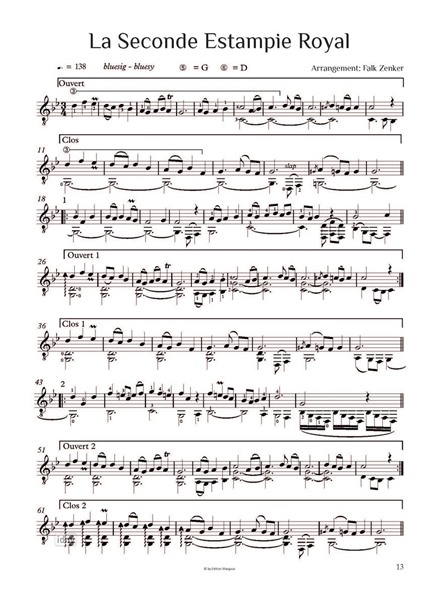
The Estampies Royales are regarded as the oldest traditional instrumental music of the Occident. With this edition I invite the advanced guitarist to discover the earliest source of our instrumental music today and to explore my new interpretations of this precious medieval treasure.
The accompanying musicological transcriptions of the original melodies can give the guitarist an insight into the historical material, as well as giving other instrumentalists access to this early instrumental music.
The royal estampies are to be found in the sumptuously ornamented Manuscrit du Roi, also called Chansonnier du Roi, which was compiled as a collection of French troubadour songs in the thirteenth century and to which additions were later made. The monophonic series of melodies are clearly instrumental pieces, courtly dances to which one presumably “stamped.”
Labeled “Estampie Real” or “Estampie Royal”, they are sequentially numbered.
In terms of form, each estampie consists of four to seven different strophic melodies, called puncti, and is characterized by two recurring, refrain-like endings.
The open ending ouvert is played after the fi rst statement of the respective strophic melody, with the second statement ending with the clos. Judging from the form of the notation, two scribes added the dances into the manuscript in the period between 1290 and 1310 at the latest. Music of this kind has so far not been found in any earlier manuscripts.
And it can certainly be considered a particularly fortunate circumstance that the melodies were written down at all, for at this time the musicians usually handed down their repertoire orally.
During this period, Europe as a whole was marked by lively cultural exchange, with customs-free roads full of travelers: pilgrims, merchants, vagabonds, knights in search of adventure, crusaders, and, naturally, minnesingers and minstrels of all social ranks. Court musicians ranked relatively high on the social scale. Well-trained, they played for the entertainment and the dances of the courtly society, accompanied the minnesingers and troubadours on their extended journeys from court to court, or traveled on their own across the Occident.
They certainly also carried with them the estampies, which in themselves were an expression of the cultural abundance of the time.
Seven hundred years of early music that lets us look back as if through a window of time to the origins of our present-day music, and through which I want to move this music into the present.